
March 24, 2026
Kawasaki Kisen Kaisha, Ltd.
Kawasaki Kisen Kaisha, Ltd. (“K” LINE) has been participating in the MEGURI2040 Fully Autonomous Ship Project (MEGURI2040) *1, which aims to realize fully autonomous ships and ensure stable transportation of people and goods, administrated by the Nippon Foundation. Through this participation, “K” LINE is advancing initiatives to address urgent issues facing the maritime industry, including the crew from population decline and accidents resulting from human error.
“K” LINE announces that the demonstration tests of autonomous navigation have been completed for the scheduled domestic RORO vessel “HOKUREN MARU No.2”, connecting the Kushiro–Hitachi route, operated by Kawasaki Kinkai Kisen Kaisha, Ltd. (Kawasaki Kinkai Kisen). The vessel obtained certification related to autonomous ships from Nippon Kaiji Kyokai (ClasssNK) dated January 27, 2026, and subsequently passed the statutory ship inspection by the Ministry of Land, Infrastructure, Transport and Tourism (MLIT) as an “autonomous vessel” dated February 9, 2026. This is the first case in Japan of a RORO vessel passing such inspections*2. As a result, “HOKUREN MARU No.2” can utilize autonomous navigation functions equivalent to Level 4 of the SAE Levels of Driving Automation*3 even during commercial voyages, which is expected to mark a step forward toward realizing more efficient cargo transportation.
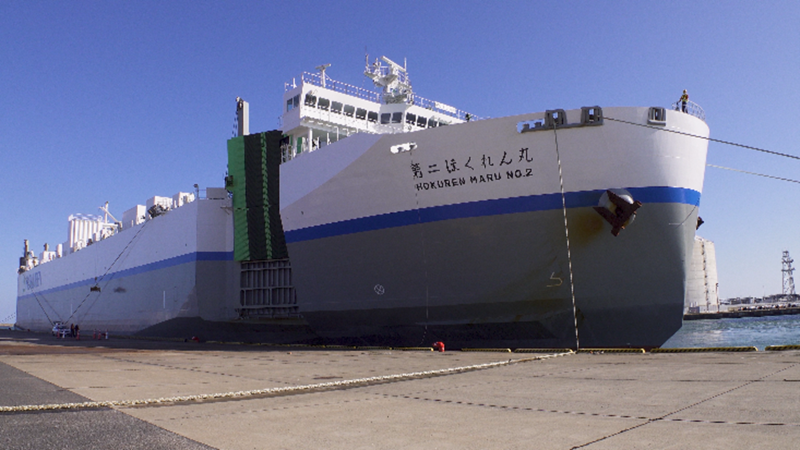
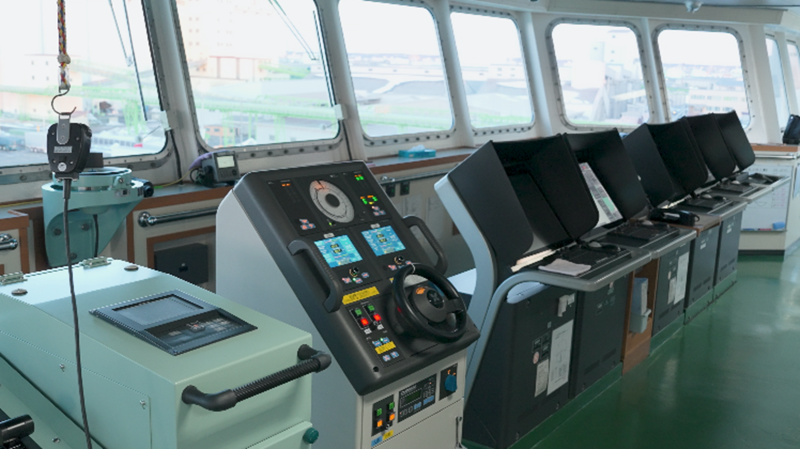
About the RORO vessel “HOKUREN MARU NO.2” and the demonstration trials/statutory ship inspection
“HOKUREN MARU No.2” is a domestic coastal RORO vessel (approximately 173 meters in length and 11,413 gross tons) operated by Kawasaki Kinkai Kisen. The vessel is engaged in transporting agricultural products, mainly raw milk, from Kushiro Port in Hokkaido to Hitachi Port in Ibaraki Prefecture. The vessel is one of the four demonstration ships in the Nippon Foundation unmanned autonomous ship project and aims to realize autonomous navigation through retrofit of an existing domestic coastal RORO vessel (i.e., enhancing performance by adding new functions to existing equipment).
To sail a vessel, it is necessary to pass statutory ship inspections that confirm compliance with technical standards prescribed by the government. In June 2024, MLIT established the “the Advisory Committee on MASS” to examine safety standards and inspection methods for autonomous vessels, and published the study results in June 2025. In order to operate as an “autonomous vessel,” a ship must undergo inspections to confirm, among other matters, that systems such as sensors and planners (which automatically plan collision-avoidance routes) operate properly. “HOKUREN MARU No.2” passed the national statutory ship inspection as an “autonomous vessel” on February 9, 2026.
Our Initiatives
In MEGURI2040, “K” LINE has been participating in the RORO Vessel Working Group and, together with Kawasaki Kinkai Kisen, Japan Radio Co., Ltd., and YDK Technologies Co., Ltd., is working to develop the integrated bridge officer support system “Advanced Maneuvering Assistant System (AMASYS)” and to convert existing vessels into autonomous ships through retrofit solutions.
To help resolve social challenges in Japan’s domestic coastal shipping—such as mitigating labor shortages and reducing workload burdens, preventing marine accidents, and maintaining routes serving remote islands—and to support stable domestic logistics and transportation infrastructure, “K” LINE will continue to advance MEGURI2040 in collaboration with the Nippon Foundation, the participating companies of the DFFAS+ consortium, and cooperating organizations in Japan and overseas.
*1 MEGURI2040 Fully Autonomous Ship Project — “Grant Program for Technology Development Toward Social Implementation of Unmanned Autonomous Ships”
A grant program that supports relevant technology development in order to foster further momentum for R&D in this field and, as a result, promote transformation of Japan’s logistics as well as its economic and social foundations.
A consortium of 53 diverse domestic companies has been formed under “Designing the Future of Fully Autonomous Ships Plus” (DFFAS+), working together on technology development for unmanned autonomous ships.
https://en.nippon-foundation.or.jp/what/projects/ocean/meguri2040
*2 According to the Nippon Foundation (as of March 2026)
*3 A technological level where fully autonomous navigation is partially available, Level 4 indicates fully automated operation in a designated area under certain conditions without human intervention. (The definition of automated operation for ships is currently being discussed at the International Maritime Organization (IMO). For convenience, the definition for automobiles is used.)
https://www.mlit.go.jp/common/001226541.pdf (Japanese only)
(Related Releases)
Dated November 27, 2023: The Nippon Foundation MEGURI2040 Fully Autonomous Ship Project
-Demonstration test of autonomous navigation system on large RORO cargo-
https://www.kline.co.jp/en/news/csr/csr-20231127.html
Dated July 21, 2023: Participating in the Second Stage of the Nippon Foundation MEGURI2040
https://www.kline.co.jp/en/news/csr/csr-20230721-1.html
(Reference)
MLIT, “Overview of Inspection Methods for Autonomous Ships”
https://www.mlit.go.jp/maritime/content/001884711.pdf (Japanese only)