
March 16, 2026
Kawasaki Kisen Kaisha, Ltd.
Kawasaki Kisen Kaisha, Ltd. (“K” LINE) is pleased to announce that third-party reviews of the “Seawing” automated kite system, which utilizes wind power, being developed by OCEANICWING S.A.S. (OCEANICWING), a subsidiary of “K” LINE in France, have been successfully conducted by Bureau Veritas Marine & Offshore (the French Classification Society, hereinafter "BV") and Nippon Kaiji Kyokai (ClassNK), analyzing the tension performance of the system. OCEANICWING continues to conduct onshore and offshore demonstration experiments, moving toward the practical use of “Seawing” systems by around 2027.
About “Seawing”
Harnessing wind power, “Seawing” can be installed on any type of vessel, including existing vessels. It is expected that there will be synergy between “Seawing” and the efforts to transition away from conventionally used heavy fuel oil to other fuels such as liquified natural gas (LNG), and that the performance of “Seawing” will increase in terms of the reduction of CO2 emissions. Several wind-assisted propulsion systems (WAPS) are being developed, but compared to other WAPS, “Seawing” is able to generate a comparatively large amount of thrust using high-altitude wind.
Phase one of “Seawing” ’s development was completed in June 2025, and OCEANICWING verified the tension and performance of the “Seawing” system using a 300 m2 kite at an onshore test site. OCEANICWING has confirmed that the results of these tests have been good.*1
About the third-party reviews
BV and ClassNK based their reviews on the test results obtained during phase one of the development project, and they confirmed the appropriateness of the validation process used in the demonstration tests with the 300 m2 kite. In the reviews, it was confirmed that the theoretical tension from the 300 m2 kite used in phase one of the development project is 25 tons, and if the size of the kite were doubled to 600 m², it is expected the theoretical tension would also double to 50 tons. This can be validated through further testing.
This 50-ton tension is equivalent to the towing force of a typical tugboat.*2 The tension generated by “Seawing” will depend on wind conditions, but it is expected that it will achieve an annual average fuel consumption reduction of more than 10% for large bulk carriers.
Actual energy savings will vary depending on ship type, speed, route and season. In certain combinations of these factors, fuel consumption may be reduced by significantly more than 10%.
Future of the project
“Seawing” has now entered phase two of its development, in which OCEANICWING will increase the size of the kite and verify the operability and safety of the “Seawing” system at its onshore test site, in preparation for the shipboard use of the system. OCEANICWING will also conduct offshore demonstration experiments using a large bulk carrier owned and operated by “K” LINE to verify tensile strength and reliability. The goal is to complete the tests by around 2027 and move toward the practical use of “Seawing”.
Comment from the Board of Directors
Takenori Igarashi, the President & CEO of “K” LINE, said, “ “Seawing” ’s effectiveness has been reviewed by BV and Class NK, who are third parties. It has been confirmed that by increasing the size of the kite, it is theoretically possible to achieve significant tension that will result in the reduction of fuel consumption by more than 10%. We will continue to develop the system so that it can be used on ships. We plan to develop this innovative energy saving device that harnesses wind power into a great solution that helps achieve the decarbonization of the shipping industry.”
The “K” LINE Group will continue to work to contribute to the sustainable development of society and the economy and increase its corporate value based on “K” LINE Environmental Vision 2050, the Group’s long-term environment management vision, as it moves toward 2050. “K” LINE will maximize the use of wind, a renewable source of energy, in the propulsion of the vessels to contribute to the low-carbon initiatives of not only “K” LINE, but also “K” LINE’s customers and society as a whole.
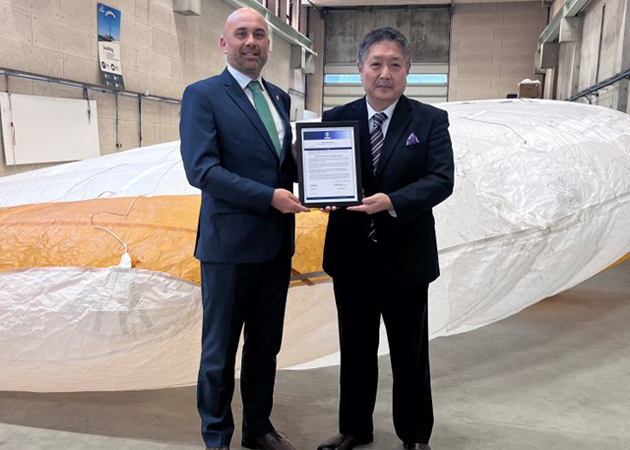
- 拡大
- Certification Ceremony with BV at the OCEANICWING office in front of kite
Left: Julien Boulland, Sustainability Strategy Leader, Bureau Veritas Marine & Offshore
Right: Shingo Kameyama, CEO, OCEANICWING
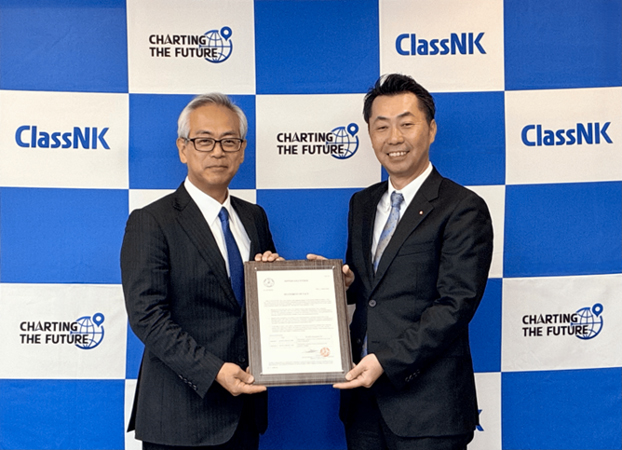
- 拡大
- Certification Ceremony with ClassNK at ClassNK Head Office
Left: Masaki Matsunaga, Executive Vice President, Nippon Kaiji Kyokai
Right: Shingo Ikeda, Management Corporate Officer, Kawasaki Kisen Kaisha, Ltd.
Verification of “Seawing” ’s perfomance at the land test site
*1 September 4, 2025 news release
Phase One of the Development of“Seawing” Automated Kite System Harnessing Natural Wind Power Completed
https://www.kline.co.jp/en/news/csr/csr-20250904.html
*2 Tugboats are ships that assist large vessels in safely departing and arriving at ports by pushing or towing them. They possess powerful towing capabilities necessary for maneuvering large ships. The towing force of a typical harbor tugboat is around 50 tons, making them highly effective tools used in common port operations.